Bored at a slow work day I arrange some of the left-over wedding flowers in the lunch room. I set them inside a pitcher of water and then mop the floor. I do not think hard about flower arranging, but it looks fine to me, they’re beautiful enough, you can’t go too wrong. One might think that I’m building poems in my head while I do my duties, but most of the time I’m not thinking about very much. Mostly just daydream mundane thoughts, or just pay attention to the task and any small satisfaction I receive from it. The gleam of a clean counter top or opening a new garbage bag with that quick arm motion that forces air into it. I read on my break more often than write. Work-gloves that have my name on them. Someone left a David Sedaris book on a shelf that has now become an unofficial ‘free-book’ shelf and I’m reading that. While I was taking a “Writing for Children” class I would read a couple books a day from the Montessori classroom that is part of the building, but I’ve read most all of them now.
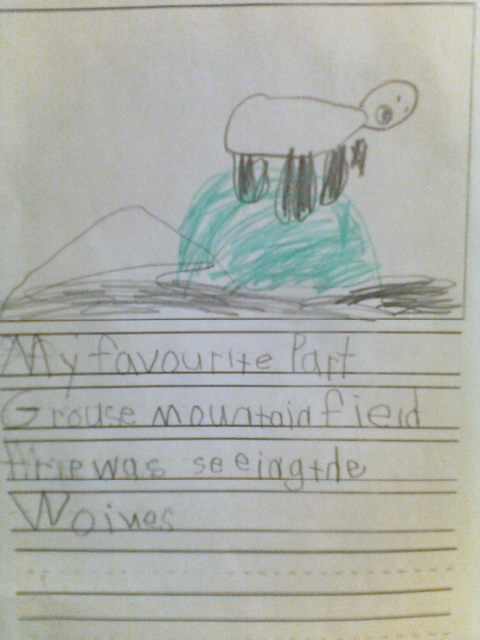
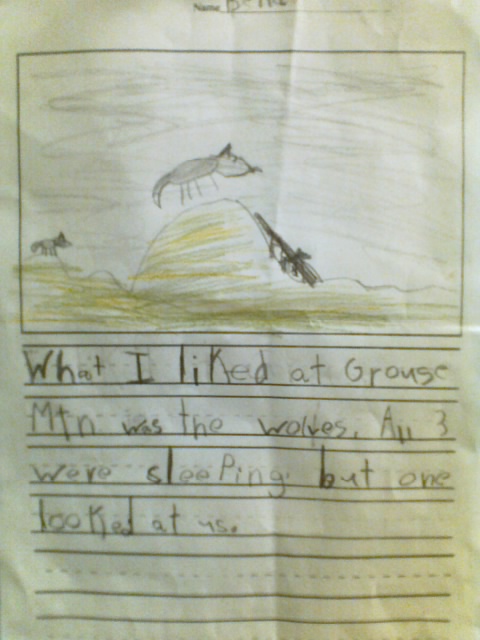
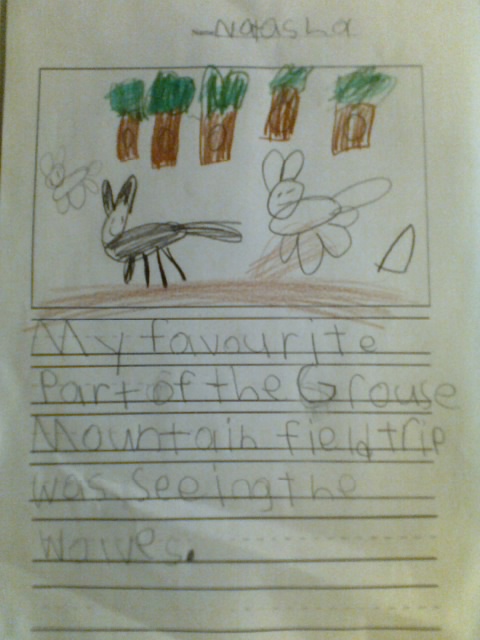
A class recently went to Grouse Mountain as a field trip and they put these up on the wall:
(I’ve been there once, and it was my favorite thing too)
A bunch to catch up on. The Victoria reading was awesome, even though, in terms of stutters and mumbles it probably was my worst. My mouth was perpetually dry and, I don’t know, mistakes tend to create this feedback loop. Glitches all around. Still, probably the loveliest crowd (who seemed to be o.k., or even charmed by my nervousness) and one of the nicest venues (I always want super-8 loops to be playing behind me during readings!) and so well organized. Open Space is my favorite thing about Victoria right now.
I read some Cloud Farm stuff that seemed to go over really well, so I’ll try and incorporate that in more readings. Also threw in some poems by my friend Rob Taylor, who’s got a new book. Anne-Marie was spellbinding, Garth wielded language like a master swordsman. Then we went and drank lotsa beer and danced manically to a local cover band.
The following Monday was the w2 reading that also was a lot of fun. I read last, which means I had at least 3 beers in me; noticeably better for my nerves. Also, video! probably the first time I’ve got to watch myself reading and yes, dear readers, it’s as mortifying as you may imagine. Still, a good learning experience, and there are a bunch of things I can be aware of now, to improve how I read. I’ll maybe save the thoughts for another post, and just let you watch it. I did dedicate a poem to The Internet so I can’t really make excuses not to share. Also, thanks again to Sean Cranbury for making it all happen (and for holding onto the hat I left behind at the bar.)
Spending the day putting together some poems to read for the upcoming “Hat Trick” reading in Victoria, with Garth and Anne-Marie (The other two finalists from the Bronwen Wallace Award/ my new gang?) It is sort of a celebration of the fact of all of us finalists being from British Columbia. Open Space, a non-profit artist-run centre, is putting it on, and they seem to be good people. I’m looking forward to check out what they’re all about. Part of what is making this exciting is that they are selling broadsheets of a poem by each of us, that a local artist, Chelsea Rushton, has illustrated. I have seen what Chelsea has drawn for mine, and it is totally awesome.
They’re giving a generous 20 minutes for each of us to read, which is something I haven’t prepared for in a long time. I’m nervous, but hoping to make the best of it by showing a range of my work, in different styles/forms. (This make s me realize that I should try more different forms. Right now it seems like it’s mostly a lot of free-verse, some list-poems, some haiku. I should have some villanelles under my belt? ghazals? Even rhyming poems?)
I’ll be spending a day and a bit on Mayne Island before coming over to Victoria so it should be good for my nerves and I’ll practice reading to the deer and woodpeckers if they can stand it.
Couldn’t think of a good rapture-y poem but here’s one of my favorite end of the world-ish songs.
The Mountain Goats and Kaki King – Black Pear Tree
I dug a hole and filled it up with compost
Rested on the cool grass for a minute
I saw the future in a dream last night
There’s nothing in it
I set the sapling in the hole
Started gently tapping down the dirt
I saw the future in a dream last night
Somebody’s gonna get hurt, somebody’s gonna get hurt
I hope it’s not me
But I suspect it’s going to have to be
I dug my heels in for the winter
And I waited for the snow
But something was stuck up in the clouds
Something was stuck up there
It couldn’t let go
And when its time came I could see it happen
Blossoms black and sweet as Texas crude
I saw the future flowering like a ruptured vessel
Somebody’s gonna get screwed
It won’t be me
Someday I am going to walk out of here free
I got into writing haiku in a sort of odd way. I was enjoying seeing some of my poems getting smaller and more compressed. Being a very fragmented writer, if I could figure out a way of turning a single sharp observation into a small but complete poem, I’d go for it. I hadn’t really read much haiku though, but one night at the bookstore at the old Virgin Music downtown, I picked up a copy of this book called The Haiku Year. It was a project where a bunch of friends decided to write a haiku every day and mail them to each other. The book complied them all together. One of the writers was Michael Stipe of R.E.M., which helped with the appeal, at the time.
They were lovely little things, that didn’t always followed the rules. One of the “rules” that many people associate with haiku, the 5-7-5 syllable structure, was thrown out the window. I learned later that this rule has been justifiably discarded by most ‘serious’ contemporary English haiku writers, despite it continuing to be taught in schools, and adhered to, generally, by a lot of people when they sit down to write haiku. (More on this, later.)
Anyway, inspired by the book, I started writing a lot of 3-liners that also didn’t bother with the 5-7-5 either (maybe it was too much like math) but concentrated on compression and the ‘surprise’ of a sharp turn. I started sending a few out to some contemporary haiku or short-form journals, one of them being Tundra, edited by Michael Dylan Welch. I don’t have a copy of what he wrote back, but I remember it being gracious and taught me at least one common mistake people make with haiku:
The plural of haiku is haiku. Not haikus. (I still, perhaps somewhat irritatingly, continue to point this out to people at any chance I get.)
For a while I was obsessed with writing them, very much like a boy with his first camera. Going for walks I would filter everything I saw through that lens. I also found them a lot easier to send out because of their brevity and lack of any personal/emotional mucking around. So I did, and got a handful accepted in some journals. Michael also got me in touch with a local haiku group that helped me a lot with my development.
Here’s one I got accepted in a magazine called Acorn in 2002
*
power failure –
the kitchen sink
fills with moonlight
*
I had come here to talk about the rules or guidelines I have learned that make haiku such a beautiful mode of expression, but I’ve already taken a while getting here. I’ll save it for the next post, but in the meantime, I recommend you read this essay Becoming A Haiku Poet by Michael Dylan Welch, and if you want to get into the nitty-gritty about the form, there’s this essay by Keiko Imaoka.
Or an even better idea – for the people reading this in Vancouver, you could come down to theCross-Border Pollination Reading tomorrow at 5pm at SFU where Michael Dylan Welch will be reading among some other great writers, including Catherine Owen and Jericho Brown. p.s. (Jericho Brown and Michael will also each be doing a workshop the following day at the Joy Kogawa House. More info on that here.)
Going to a bookclub meeting today where we will be discussing the book “Peepshow with a View of the Interior: Paratexts” by Aislinn Hunter. I deeply enjoyed it. Here is a passage from within it:
“I think that in the same way that we are too often guilty of the misuse of language, or of the wilful loss of language, we are, some of us, also sometimes guilty of failing to contemplate the physical world. This is partly because we don’t need to contemplate objects for survival to the same degree that we once did (I’m thinking here about dangerous landscapes, animals, poisonous versus edible plants etc) but also because we have so many shorthand conventions to direct us (for example: signs that yell DO NOT ENTER in huge font, a seemingly infinite number of labels, and patterned contexts – maybe aisle 2 in your supermarket is always breakfast cereal – etc) and partly because we live in the hyper-drive of a sign and image-laden world. Visual literacy is a kind of seeing but in the modern urban world it rarely affords for a leisurely read. It’s also possible that as we get older some of us lose the child’s wonder at how things work. We sometimes forget that objects, if studied, can open up, reveal secrets, tell stories and take us places. We forget that the alarm clock was once a village rooster.”
Ok, I’ll say a little more. The particular copy of this book, checked out from the library, has the Vancouver Public Library bar code sticker on it. On the base of the book, (if you imagine the book shelved upright, the base that touches the shelf it sits upon) made up of the 103 pages bound together, it is stamped “Feb 2010.” I am certain that there must be a better way of explaining that. Unlike the image above, in my copy, the title and authors name is gently embossed in a mirrory silver. The front cover is slightly damaged (the surface peeled, probably from the removal of a sticker) at its lower left, this damage follows over the spine and onto the back, but stops before it obscures any text. The back text has a possible error – the last two sentences reads: “…Taken together these essays investigate the degree to which we can understand or know the material and obdurate world and the manner in which language, writing and writers seek to evoke and celebrate it. Language, writing and writers seek to evoke and celebrate it.” It is hard to be certain if the repetition is an error. The pages inside have a pleasant visible texture; one can make out the pages have been distressed in subtle horizontal rows. The font is Adobe Garamond. Page 46 and 47 have tiny stains, probably from coffee (probably my coffee.)
***
Additional note: It just popped into my mind, while observing the book – when I used to send letters or packages to people I used to have a fear of strands of my hair making its way into the fold of the letter or the envelope and would carefully check the contents before sealing it. This was more an issue of invoking a possible unpleasant hair-in-my-soup reaction than worry about my DNA getting around.
Some of my poems obviously became more public recently; significantly, to some of my family members who don’t usually read any poetry, let alone mine. My mom said they were ‘weird’ (though my brother said they were “dope”!) and I got a few glazed-eye responses from others. I realized it’s been a while since I’ve talked to people who are very much outside the poetry sphere about poetry, and I was curious to get a sense of what people think of it these days.
I could have asked friends on facebook but worried they might be too sparing – so I headed over to the AskMeFi section at the community blog Metafilter and asked a question: Why not poetry?
I got over a hundred and thirty responses. Its worth reading – a lot repeat what’s already said, but there’s some thoughtful and sobering comments in there (sobering if you’re a poet, but maybe reassuring if you’re someone who can’t stomach the stuff; you’re far from alone.)
Some of them were expected : That it requires a lot of work/attention, it lacks plot, it’s too personal or navel-gazey, the signal-to-noise ratio is too high to find the good stuff. I’ve heard a lot of these complaints from poets, too.
Actually, the ‘ personal’ thing has interested me for a bit, because I don’t think a lot of my work as very personal. I remember being asked how do you share something so personal and it was like, does an architect have doubts about designing a building because it’s too personal?
(Sincere apologies to architects for the comparison.)
One of the things that surprised me was the pining over the lack of rhyme and meter in contemporary poetry. What I’ve noticed is that unless you’re terribly good at it, most poets get laughed out the room when they do it (I must admit I roll my eyes at a lot of it.) I suspect that a lot of people exposure to poetry in highschool was a lot of Shakespeare, and it’s hard to see the kind of fragmented, stream-of-consciousness of today’s poetry as, well, poetry. This is a issue with education and I’d like to think it’s changed but I don’t know for sure.
here's a little legend for the never believer / here's a little ghost for the offering
Relatedly, there were a few people who said they get their poetry fix from lyrics in music and I can definitely relate to that. In my young years, before I actively read much poetry, I probably would have said my main poetic inspiration were Nirvana or R.E.M. A good melody with the right delivery can make the simplest of phrases feel like gospel.
I want to respond to a lot of the comments but I’d like to keep the dialogue going with the obvious questions: How can poets address these issues? Does it require sacrificing some of its qualities to be able to connect with people who don’t like the stuff? What are the cultural perceptions of poetry (that the only way to read it is to decipher it, scalpel in hand, for example) that are misguided? Should poetry try to incorporate other mediums or forms to get their work across? Why are we being cryptic and alienating; or is just that the whole idea is to distress or obfuscate meaning? What are poets that are generally liked by the masses doing differently? Should we ban the popular style of precious drawn-out-monotone readings that makes me want to stab myself with nearby dinner utensils?
Feel free to use the comment section to voice your thoughts! I’ll leave you with one of the the many comments I enjoyed from the thread:
“There are individual poems that I love with a great fierceness, but poetry as a genre leaves me cold for the reasons others have already mentioned. It’s so hard for someone to do it well, and when it’s done badly it’s so much worse than bad prose. I think there’s actually a lot of amazing poetry in the world right now, but it might be in the form of song lyrics, or kids books, or advertising jingles, or, I don’t know, LOLcat captions… Basically, the more someone insists that poetry is completely different from all of those things, the more I tend to expect their poetry will be inward-focused, pretentious twaddle. Those that focus less on what their work is called and/or if it’s going to earn them the proper academic credibility, and more on describing a piece of life in an accurate, relateable way, tend to be the ones that can unexpectedly gut-punch me with laughter, or sadness, or fear, which I’ve always felt was one of poetry’s strengths as a form.”
posted by MsMolly at 1:41 PM on April 27
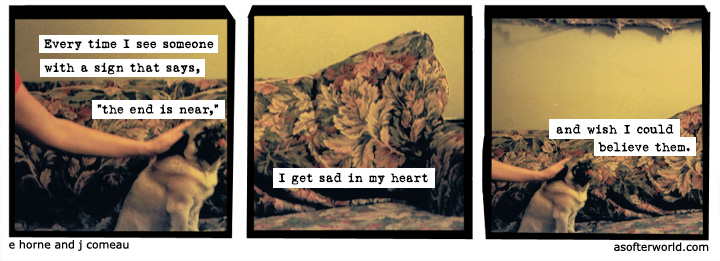
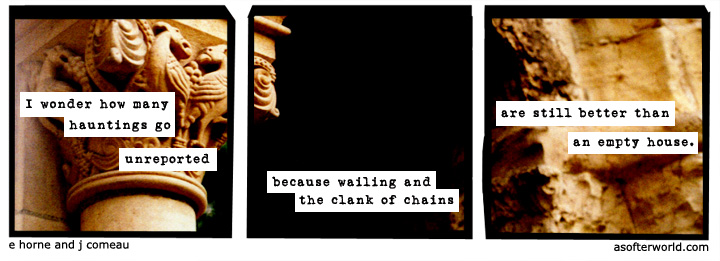
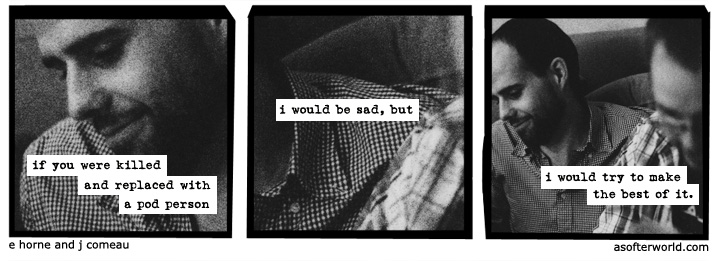
My first evening in Toronto I went to see the Mountain Goats at the Opera Hall (There will be more on the Mountain Goats later! Likely too much!) After the show I was waiting around to see if John Darnielle would come out so I could fist-bump him or something. One of the other people waiting around was Joey Comeau who, with Emily Horne, is responsible for the darkly funny webcomic A Softer World. Here is a sample of what they do.
(click to see the full-size version)
I’ve been following A Softer World for so long, it feels like daily medicine. If you’re someone who cringes at inspirational posters/idioms or hallmark cards, their brand of acidic humour will come as a sweet antidote.
I would have probably drifted away from it, though if the comics stayed in one cynical tone though. There are moments of complex emotion; those weird un-talked about dynamics of relationships are summed up so succinctly, at times its almost a shock to read them. And one day’s comic could be strangely life-affirming, the next almost heartbreaking.
Part of A Softer World’s magic are the photographs that stand in as the visual component. Often, but not always, there are people in them but they are usually out-of-focus, grainy or oddly cropped. It makes me think of the kind of incomplete, dreamy images that come up in your mind when you’re trying to remember what happened at the party last night where you had too many whiskey sours and blacked out. The images and the text are kept at a distance which prevents them from overstating the meaning of the comic. Its a tricky thing to do well, and somehow over the years, they’ve mastered it.
I was probably a bit of an annoying fanboy when I talked to Joey in Toronto, but I remember saying that as a writer, his comic has been a great inspiration to me; I meant that. I think a lot of writers could learn from how much can be said with an ordinary sentence, simply by twisting its end or turning it on its head.
Anyway, congratulations Joey and Emily on an awesome comic and the other awesome projects you do!
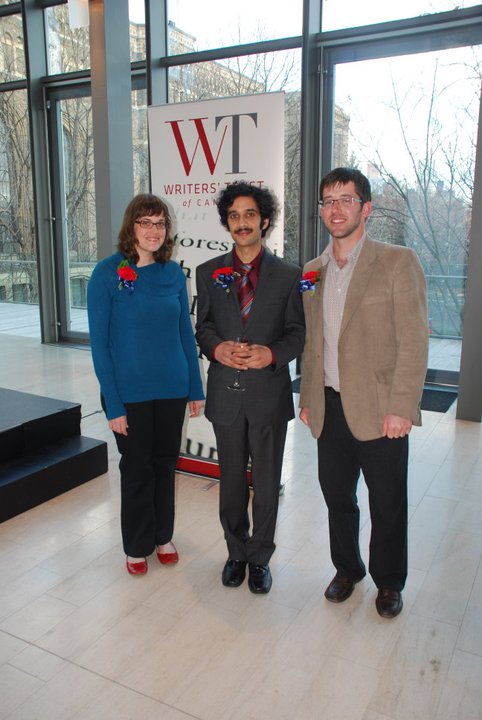
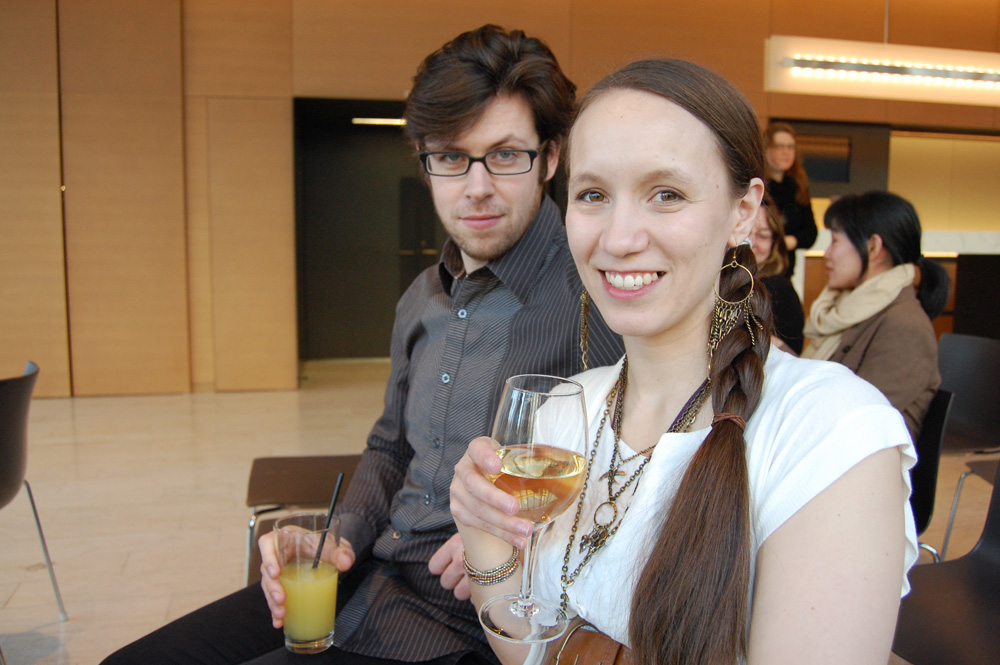
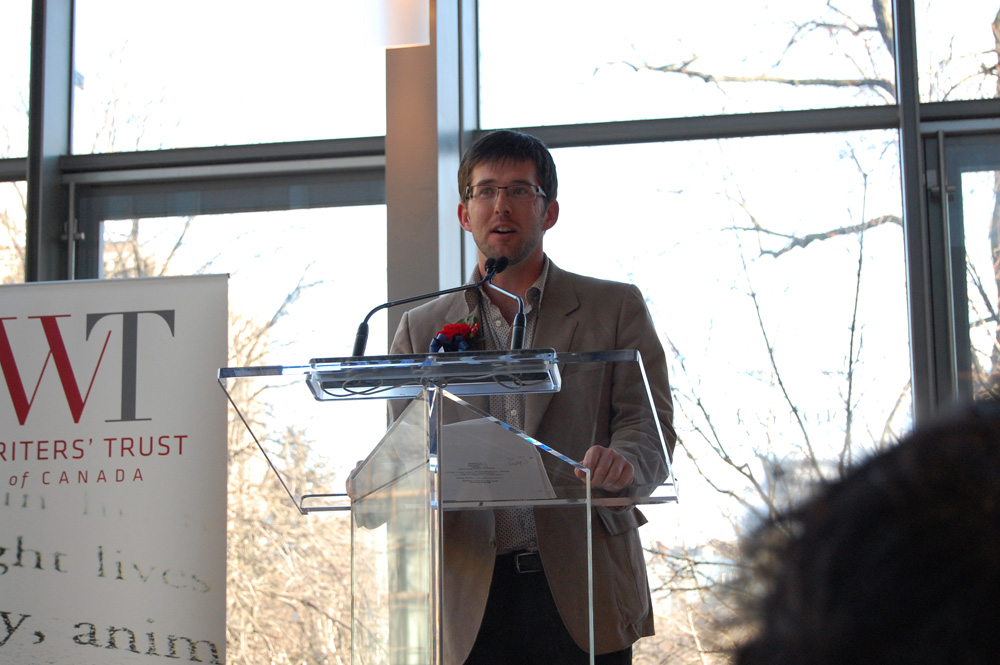
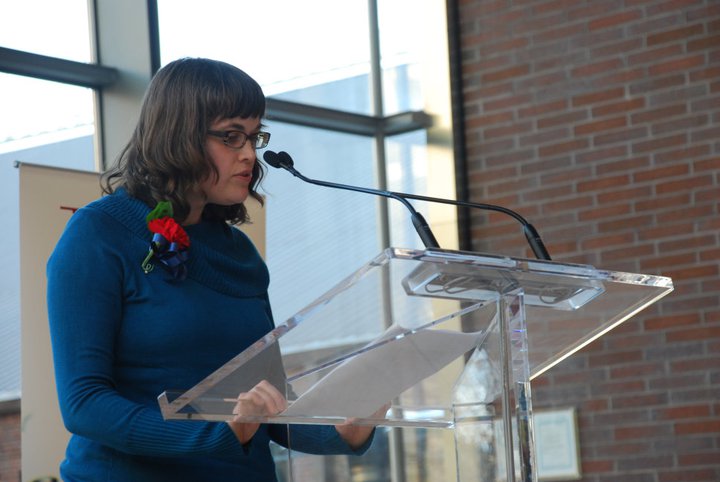
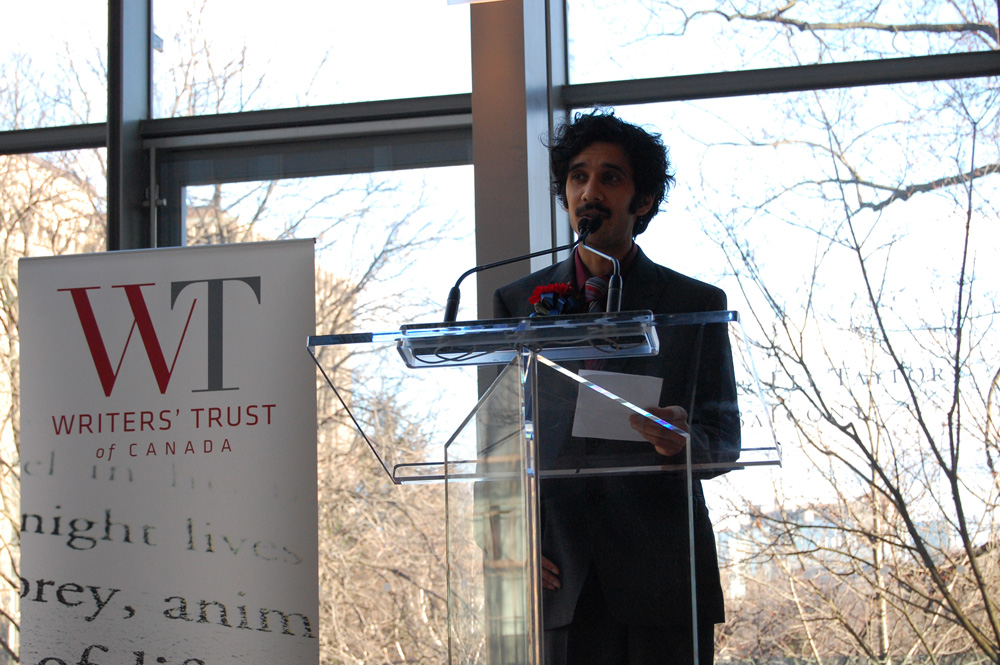
I’m not feeling too wordy, so ‘ll let some pictures do the talking. I want to emphasize again how generous and welcoming the Writers’ Trust was to us finalists, and how much fun and great conversation I had with Garth Martens and Anne-Marie-Turza. As surreal as the whole experience was, I felt grounded by the genuineness and support of everyone around me.
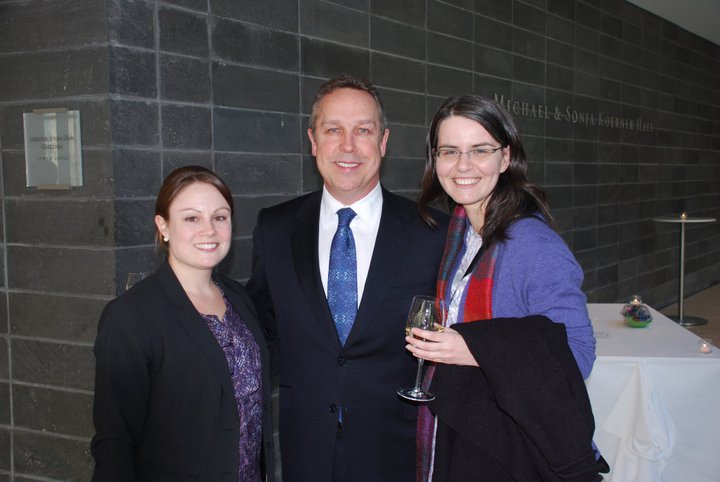
Anne-Marie, me, and Garth, with flowers on our clothesMegan and I, and our friends Lindsay and Nick. I know them from Vancouver, and Lindsay particularly from the Writer's Studio where she was in my poetry group. It was so great to have them there and to kindly offer their place to us for a couple nights.Lindsay and Nick again because they just look so damn good here (photo by Megan)Me with Peter Kahnert, a board member of the Writer's Trust and wonderful poet, Adam SolAmanda Hopkins, Peter Kahnert, Kilby Smith-McGregor. I would like to especially thank Amanda, my main point of contact with the Writers' Trust, who helped make the experience so smooth and welcoming.Garth Marten reads (photo by Megan)Anne-Marie readsI read (photo by Megan)My award to myself: Justifying wearing a hat like that. (photo by Megan)
See more pictures at the facebook page for the Writers’ Trust.






 Raoul Fernandes